
Pay Equity and Compensation Mechanism
Pay Equity and Compensation Policy
CHC upholds a profit-sharing philosophy aimed at attracting, retaining, developing, and motivating outstanding talent by offering a diverse and competitive compensation system. Salaries for new hires are consistently set above the legal minimum wage and are determined based on position level, educational background, work experience, and professional qualifications. Annual bonuses are linked to individual performance, and compensation is not influenced by race, social class, language, ideology, religion, political affiliation, nationality, place of birth, gender, sexual orientation, age, marital status, pregnancy, appearance, facial features, disability, astrological sign, or blood type. While compensation levels are determined by job nature and technical requirements, and the structure reflects differences in position levels and seniority, CHC acknowledges that some differences in gender-based pay may exist as a result of such role-based distinctions. To ensure workforce stability and retain top performers, CHC reviews and adjusts salaries annually based on inflation trends and individual performance. CHC also participates in two third-party salary benchmark surveys annually to ensure alignment with industry standards. High-performing employees may receive additional merit-based salary adjustments to further enhance competitiveness.
| Item | 2024 | YoY Change |
| Number of non-managerial full-time employees | 67 | -8 |
| Average annual salary of non-managerial full-time employees (NT$1,000) | 1,099 | +230 |
| Median annual salary of non-managerial full-time employees (NT$1,000)) | 1,023 | +223 |
Remuneration policies for members of the top management level and senior executives
1. Fixed pay and variable pay
Fixed pay: In accordance with the Company’s remuneration policy on employee compensation and remuneration for directors and managers.
Variable Pay: In accordance with remuneration policies on year-end bonuses and distribution of employee compensation.
2. Sign-on bonuses or recruitment incentive payments
Sign-on bonuses: None. However, we can exclusively sign employment benefits, such as guaranteed annual salary and special annual leave privileges.
Recruitment incentive payment: In accordance with incentive policy for employee referrals.
3. Severance pay
- In accordance with the Labor Standards Law and the Labor Pension Act.
- The Employee Welfare Committee shall provide compensation to the retired employees.
- Policies on the severance pay shall be the same for top level manager as that for other employees.
4. Clawbacks
- In accordance with the rules on performance evaluation, the payment shall be returned at the time when the year-end bonus or employee compensation is paid.
- The clawback provision for the top management level and senior management is the same as that for other employees.
5. Retirement benefits
- In accordance with the provisions of the Act and the Regulations Governing the Retirement of Directors and Appointed Officers.
- The Employee Benefit Committee provides compensation to the retired employees.
- Severance pay policy for top management and senior management is the same as that for other employees.
The organization's goals and performance regarding its impacts on the economy, environment, and people
- Performance-Linked Goals: Operational and sustainability objectives are defined by top management in coordination with the Board Chair, and cascaded across all business units. Performance evaluation of members of the top management level and senior executives is based on job responsibilities and operational indicators to ensure annual target alignment.
- Market-Based Salary Policy: Remuneration is reviewed with reference to industry benchmarks and adjusted based on the company’s financial health and operating performance, serving as the basis for compensation policy.
- Incentives and Profit Sharing: Year-end bonuses and employee compensation are determined with consideration of company performance and individual appraisals.
- Annual Salary Adjustments: Salaries are reviewed and adjusted annually based on price index movements, individual performance, and overall company performance.
Process to Determine Remuneration
CHC’s remuneration policies and decision-making processes are structured as follows:
Approval and Oversight
1. A Remuneration Committee is established to oversee the compensation determination process.
2. Year-end bonuses are provisioned monthly, with a final allocation plan proposed after the fiscal year-end. This is reviewed by the Remuneration Committee and approved by the Board of Directors.
Procedure – Labor-Management Meetings
All remuneration policies and procedures are implemented after being approved through labor-management meetings.
Market Benchmarking
CHC engages external third-party compensation consultants, including Willis Towers Watson and 104 Corporation, as reference for internal compensation planning.
Annual Total Compensation Ratio
In accordance with CHC’s Executive and Employee Compensation Management Guidelines, Year-End Bonus Policy, and Employee Profit Sharing Regulations, the following compensation ratios are disclosed:
To actively fulfill the Company’s sustainability commitments, CHC has closely aligned the annual goals of members of the top management level and senior executives with ESG performance targets. This ensures continuous improvement in environmental protection, social responsibility, and corporate governance, and promotes long-term business growth.
In 2024, ESG topics—including information security, stakeholder engagement, and greenhouse gas (GHG) emissions management—were integrated into the operational goals of senior executives and department heads. ESG targets accounted for at least 5% of departmental KPIs, with each executive responsible for developing implementation strategies aligned with their role. To strengthen accountability, ESG performance is directly tied to bonus calculations in accordance with the Executive and Employee Compensation Policy. Variable pay is determined based on ESG achievement, operational results, and individual contributions. Final compensation is proposed by the Chairman, reviewed by the Remuneration Committee, and approved by the Board of Directors.v
Performance Evaluation and Development: Personal Growth × Team Collaboration × Corporate Sustainability
CHC’s performance evaluation system integrates goal setting, competency assessment, team performance reviews, multi-dimensional evaluation, and personal development planning. Results are used not only for bonuses and promotions but also to strengthen individual capabilities, foster collaboration, and align with long-term corporate sustainability goals.
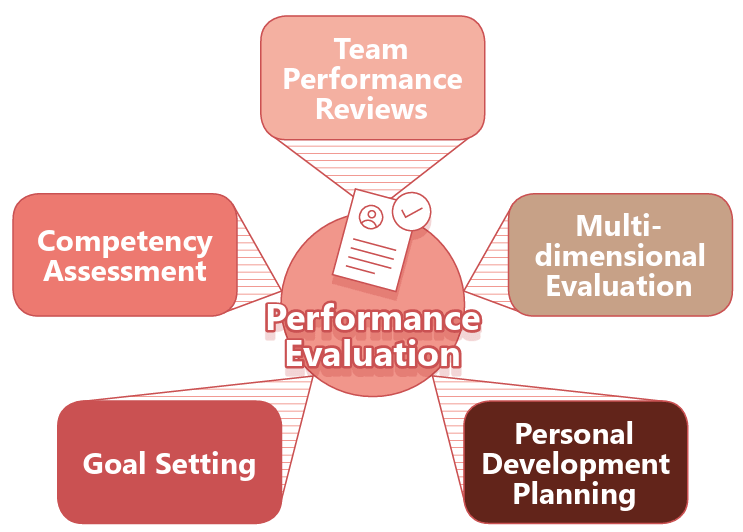
Individual and TeamOriented Approach
Annual goals are developed by the President in line with sustainability and risk strategies and are cascaded across departments and employees. Both individual and departmental goals emphasize alignment with business needs and encourage crossfunctional collaboration through clearly defined KPIs.
Three-Stage Management Process
| Beginning of Year | Mid-Year | Year-End |
| Goal setting through mutual discussion between managers and employees, ensuring goals are both reasonable and actionable | Progress reviews and strategy adjustments | Performance review and development dialogue, focused on feedback and growth planning |
Competency-Based and MultiDimensional Assessment
Evaluations include core competencies (aligned with company values) and job-specific technical competencies. Employees involved in crossfunctional projects also receive feedback from multiple stakeholders to ensure fairness and comprehensiveness.
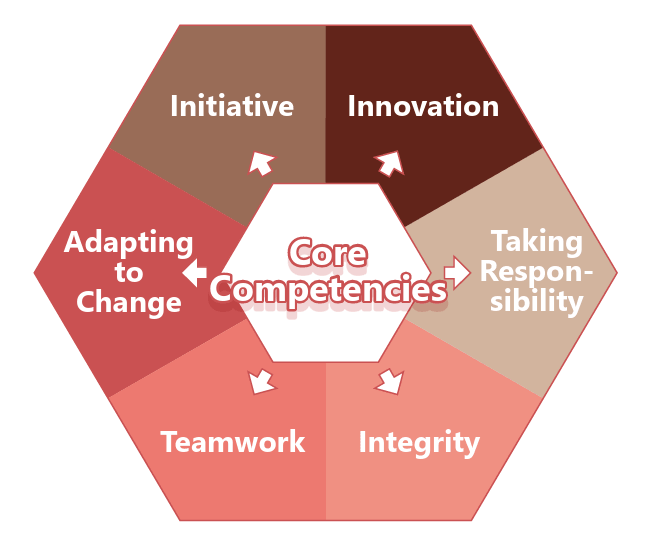
Performance-Linked Development
Beyond outcome measurement, CHC emphasizes continuous growth by integrating development plans into performance management. The process is designed to empower talent development and drive the company’s long-term sustainability
| Gender | Male | Female | ||
| Position | Managerial Positions | Non-Managerial Positions | Managerial Positions | Non-Managerial Positions |
| Number of Employees Evaluated | 53 | 87 | 34 | 117 |
| Completion Rate | 100% | 100% | 100% | 100% |
-
- Taiwan: Chia Hsin Cement Corp., Chia Hsin Property Management & Development Corp., Tong Yang Chia Hsin Intl. Corp., YJ Intl. Corp. l, Jaho Life Plus+ Management Corp., Ltd.
- China: Chia Hsin Business Consulting (Shanghai) Co., Ltd. , Jiangsu Jiaguo Construction Material & Storage Co., Ltd. , Chia Peng Gemcare Maternity (Yangzhou) Co., Ltd.
- Japan: Hotel Collective
-
- Those employed for less than three months as of the evaluation date
- Employees who resigned during the assessment period